Parkways Glide · smart power wheelchairGlide.
The power chair that tells the people who care.
Glide drives on four powered wheels with sensors all the way around, so it brakes before a bump and helps you steer clear. Parker lives in the armrest. Ask it to message your support worker, and if you ever take a knock or get stuck, the right people know straight away.
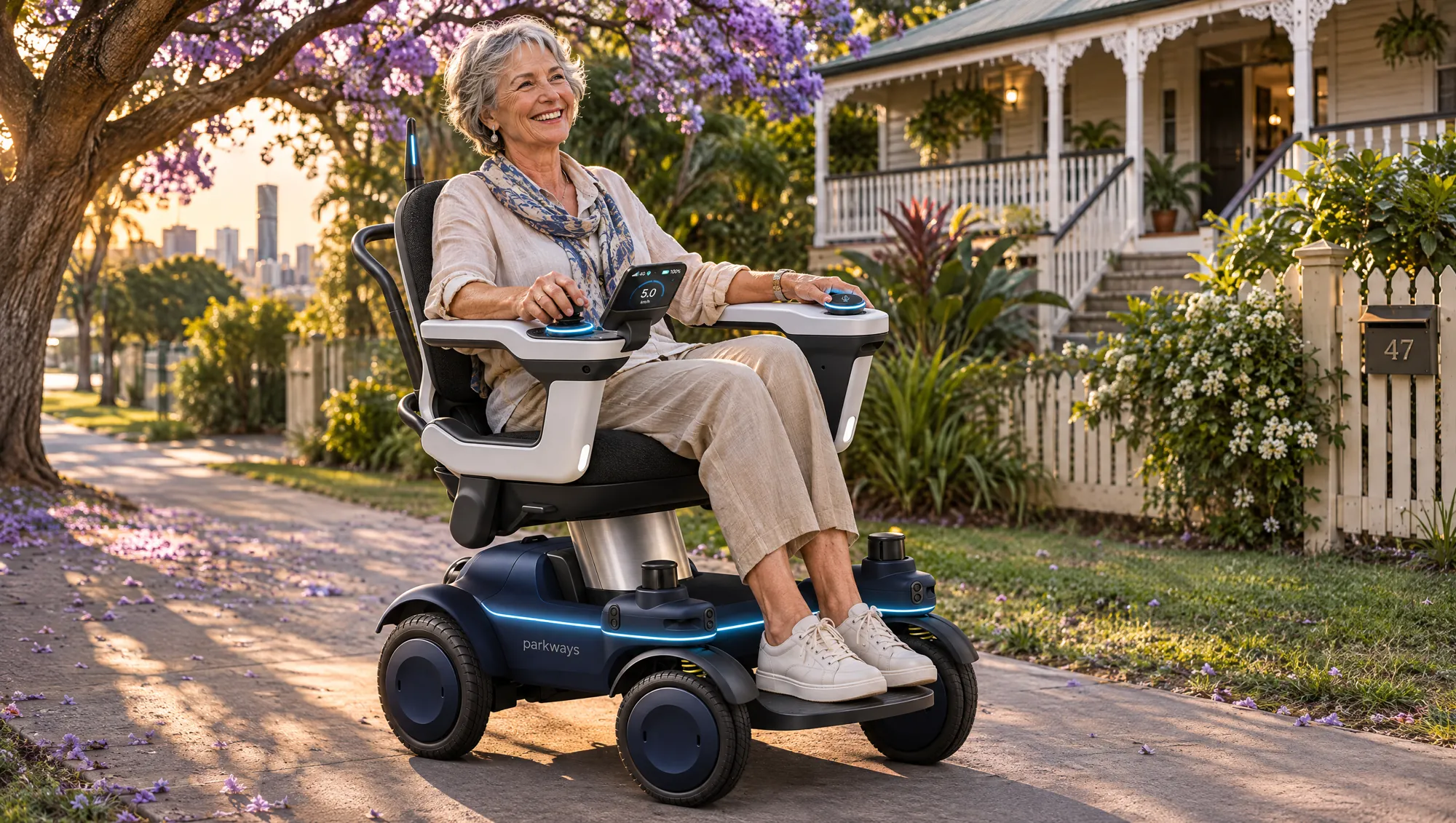
- Range
- Up to 32 km
- Charge to 80%
- Under 2 hours
- Turning circle
- 78 cm
- Weather
- IPX5
Glide, part by part.
Tap a number to see what each part does. Switch to the exploded view to see how Glide comes apart, or turn the 3D model yourself.
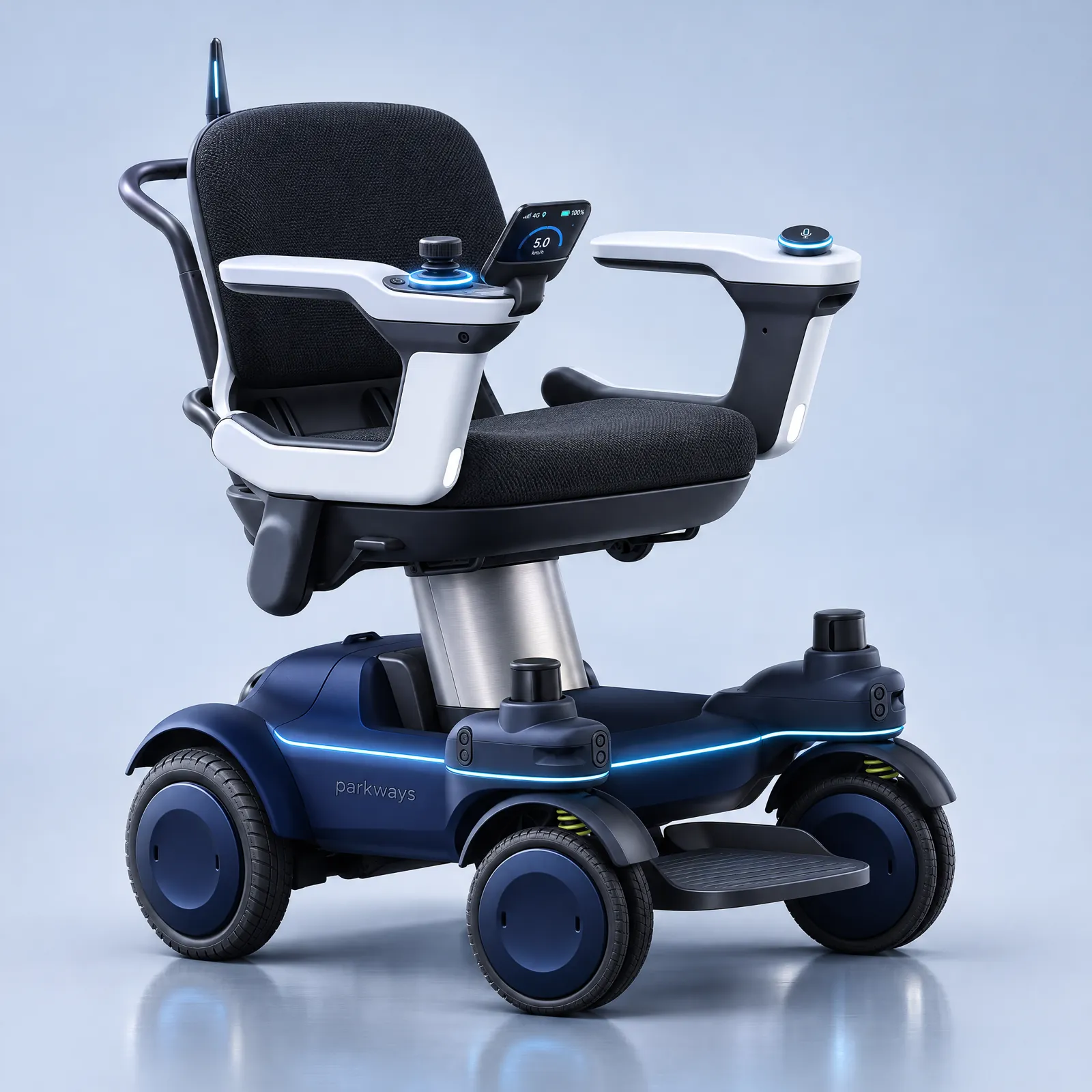
Tap a number · Parkways Navy
1. Parker voice module
A round puck on the armrest with a far-field microphone, a speaker and a Halo ring that lights while Parker listens. Press and hold for help.
Made the way you need it.
Your build
PW-GLD-NV-640-S-R
- Colour: Parkways Navy
- Battery: 640 Wh · up to 32 km
- Seat: Standard · 160 kg
- Control: Rider joystick
The spec sheet.
- Drive
- Four-wheel drive with stability control, anti-lock braking and active steering, set to an Australian speed profile
- Sensing
- 360° sensing with collision braking and assisted steering; knocks and tips are sent to your care team
- Range
- Up to 32 km on the 640 Wh battery; 288 Wh flight-safe pack available
- Charging
- 0 to 80% in under 2 hours, with an Australian-approved charger
- Seat and load
- Standard seat up to 518 mm, rated 160 kg; wide seat 560 mm, rated 180 kg
- Slopes and kerbs
- 13° slopes; heavier springs and larger tyres to clear kerbs over 50 mm
- Turning circle
- 78 cm
- Weather
- IPX5 water resistant, rated above 45 °C for Queensland summers
- Travel
- Splits into five pieces in under 20 seconds; heaviest piece 19.8 kg; tie-down points for riding in a vehicle
- Connection
- Built-in 4G and GPS, an SOS button and a live link to Parkways
- Voice
- Parker inside: check-ins, reminders, help when you ask, and a hand-off to your care team
- Finish
- Navy, Eucalyptus or Sandstone shrouds, a Halo light strip and joystick ring
Targets for Range 01. Final figures are confirmed in testing before release.
Nine modules, one chair.
Chassis, drive and sensing
Four-wheel-drive base with the 360° sensing suite, stability control and anti-lock braking
Seat and armrests
Standard or 560 mm wide seat shell; flip-up armrests with the Parker voice puck
Side shrouds
Three colourways from one tool, with the wordmark and a light-guide channel
Halo light strip and joystick ring
Diffused sky-blue LEDs with states the chair and Parker control
Connectivity module
4G on Australian bands, GPS, the SOS input and a secure chip
Parker voice module
Two far-field microphones, a 2 W speaker, a button and a Halo ring
Device identity
Every chair gets its own certificate at the end of the line, so only your Parkways record hears from it
Charger
Australian-approved charger with a standard Australian plug
Scan to connect plate
The QR code that links the chair to Parkways Connect
Tested before it rolls out the door.
Before Glide is released, every unit has to pass these. It is a medical device first and a smart device second.
- ISO 7176 wheelchair testing, including power and control systems (ISO 7176-14) and seating in a moving vehicle (ISO 7176-19)
- Battery safety to IEC 62133-2, and UN 38.3 for safe transport
- RCM approval for the charger and radios: electrical safety, EMC and ACMA radio rules
- An IPX5 water resistance report
- Inclusion on the Australian Register of Therapeutic Goods as a Class I powered wheelchair
What Parker does in Glide
- Hold the voice button and ask for help, a reminder or a message to your support worker.
- Gives your care team a heads-up when the battery is low before an outing.
- Lets them know if the chair stops somewhere unexpected or takes a knock.
- Shares where you are only when you press SOS or say it's OK.
Exactly what Glide shares, and when.
It goes into your Parkways record, stored in Sydney. You choose who on your care team sees it in Parkways Connect, and you can change that any time.
| What | What it includes | When |
|---|---|---|
| Trips | Distance, time and average speed | At the end of each trip |
| Battery | Charge, battery health and temperature | Every 15 minutes while it's on |
| Faults | What went wrong and how serious it is | When it happens |
| Knocks and tips | How hard, the tilt, and whether the chair stopped | When it happens |
| SOS | Where you are and how accurate that is | When you press SOS or ask Parker |
| Location | Where you are | Only on SOS, or when you say yes |
Questions about Glide
How far does Glide go on a charge?
Up to 32 km on the standard 640 Wh battery, and it charges from empty to 80% in under two hours. A 288 Wh flight-safe pack is available for air travel, or you can have both.
Can Glide go in the car?
Yes. It splits into five pieces in under 20 seconds and the heaviest piece is 19.8 kg. Glide also has tie-down points so you can stay seated in it in a suitable vehicle.
Who can see where I am?
Nobody, unless you press SOS or say yes. Glide only shares its location for an SOS or with your consent, and you choose who is on your care team in Parkways Connect.
Can my NDIS plan or Support at Home pay for Glide?
Power wheelchairs are assistive technology, so many people fund them through their NDIS plan or Support at Home. Your OT or support coordinator can tell you what assessment and evidence your plan needs.
When can I get one?
Glide is a Range 01 concept in development with our manufacturing partners. Register your interest and we'll tell you first about pilots and release dates.